Symtrex Inc.

Cyber Security Specialist

Call - 866-431-8972 | Send an Email | Request a Quote
Visit Us On FacebookVisit Us On TwitterVisit Us On Linkedin
  • Home
  • Profile
    • Contact Us
    • Security News
    • White Papers
  • Services
    • Compliance Regulations
      • PCI DSS Suite of Products
      • HIPAA/Hitech
      • SOX – Sarbanes Oxley
      • DCID 6/3/NISPOM Chapter 8/JAFAN DoD
      • NERC/FERC
    • Industry Consulting and Implementation
      • Banking and Financial
      • Energy/Utilities
      • Healthcare
      • Retail/Hospitality
    • Security Assessment
  • Security Solutions
    • Sophos
    • Endpoint Security Solutions
      • Bitdefender Business Solutions
      • Sophos Endpoint Protection
    • Forensic Solution – Threat Hunter
    • Network Access Control
      • NetShield
        • NetShield
    • NGFW – UTM – Perimeter Security
      • Sophos Network Protection
    • Security Awareness Training
      • KnowBe4 – Security Awareness Training
      • Sophos Phish Threat
  • White Papers
    • Sophos Webinar Series
  • Security News
    • Blog
    • Sophos Webinar Series
  • Free Security Tools

‘Shock And Awe’ Ransomware Attacks Multiply

2017/02/14 by admin

From Dark Reading - Kelly Jackson Higgins

Ransomware attackers are getting more aggressive, destructive, and unpredictable.

RSA CONFERENCE 2017 – San Francisco - The data-hostage crisis isn’t going away anytime soon: In fact, it’s starting to get a lot scarier and destructive, and with a more unpredictable outcome.

Security experts long have warned that ponying up with the ransom fee only plays into the hands of ransomware attackers; it doesn’t necessarily guarantee victims get their data back and unscathed, even though most of these bad guys thus far honor their promise of decrypting hijacked data after they receive their payment. Ransomware is rising dramatically, growing by a rate of 167 times year over year, according to SonicWall, with some 638 million attack attempts in 2016, up from 4 million the previous year. Kaspersky Lab data as of last October shows there’s a ransomware attack every 40 seconds.

James Lyne, global head of security research at Sophos Labs, warns that ransomware attacks are starting to become more of a no-win for victims, as some attackers are also now stealing the data they encrypt for further monetization, destroying it altogether, and even waging subsequent attacks on a victim. The attackers are more sophisticated with their encryption methods, and more aggressive, instituting tighter payment deadlines and including organized-crime style threats that sound more like a physical hostage negotiation, he explains.

He describes their brazen demands and attacks as a “shock-and-awe” approach that’s catching fire among cybercriminals hoping to more efficiently strong-arm their victims and potentially cash out more quickly.

“We’re seeing more and more inclusion of a timer” and a warning that the victim has X amount of time to pay the ransom or the attackers will begin to delete the files, or purge the data entirely, he says. In one attack Lyne investigated, the attackers warned the victim if he or she balked at payment or contacted law enforcement, they would delete the keys for decrypting the data so it wouldn’t be retrievable at all.

“Not even the cybercriminals can recover the data” then, he says.

“It irrevocably shreds them. You’re not going to get the data back even if you go to a forensics specialist,” Lyne says. “They’re starting to move toward a more aggressive approach of ‘hand over the money more quickly.'”

“It’s a really interesting tactic because it invokes panic in the user” so they are afraid to talk to tech support for help, he says.

Reinfection is also becoming a trend, where attackers who have successfully forced a victim to pay up to get their data back later target the same victim multiple times. “Traditional blackmailers know if someone pays once, they are probably going to pay again,” he says.

Lyne plans to show such case of a repeat attack during his RSAC session entitled Reversing the Year: Let’s Hack IoT, Ransomware and Evasive Payloads. “I’m going to show an example of where they got infected and the user pays, cleans up, and the attacker waits a period of time before doing the exact same thing again,” he says.

So the days of cleanup post-ransomware infection meaning the event is over may soon be gone. Variants such as Ranscam actually erase the victim’s files after promising to relinquish the files after the ransom is paid. The Ranscam attackers basically fool the victim into thinking the data is retrievable; they didn’t even invest in encryption, so it’s a rather evil but ingenious way to wage a low-cost, high-return attack, according to Cisco’s Williams.

Lyne says another big worry is ransomware attackers pilfering the data they locked for future monetization after the victim pays up. To date, most ransomware attacks have been opportunistic rather than targeted, even though industries such as healthcare and law enforcement have been among the hardest hit.

“In truth, most of these we’ve heard of weren’t targeted … the samples I look at have no example that they targeted specific types of businesses,” he says.

Even so, he’s seeing ransomware attackers stealing credentials and other potentially valuable data from their marks. “It encrypts your data, you pay money to get it back and it then nicks your data” as well, says Lyne, who will demonstrate one such attack here.

“It’s not widespread … but it’s something people need to be aware of now,” he says. “You can’t just pay money and consider the incident over.”

Another thing to watch for: ransomware targeting databases, which indeed is a sign of fishing for valuable data.

Headless But Deadly

Another sign of the times with the ransomware boom is campaigns that are abandoned by the attackers but still spread to victims, leaving them stranded with encrypted data and no ransom payment option. “We see this quite a lot,” Lyne says, and it tends to be lower-level, older variants such as Vipasana and Satana, and campaigns where the email or payment contact channel are shut down. “Now there’s ransomware floating around that’s shredware: there isn’t a way to get your data back,” he says.

Craig Williams, senior technical leader and security outreach manager for Cisco Talos, points to CryptoWall 3 as an example of this: “When it was abandoned, it stopped working and there was no key exchange,” which made it benign, he says.

The Talos team was seeing 130,000 ransomware samples per day in December of last year.

With the newer generation of more sophisticated and businesslike ransomware, more of the old-school rudimentary variants are likely to be scrapped in favor of more effective attack tools. Even so, the phishing emails and other ransomware-rigged places will still infect users. “This is a sign of things to come. So you should prepare,” Lyne says.

Meantime, ransomware variants such as Samsam, which included a self-propagation feature that let it spread like a worm, rather than just via email or malicious web content. Worm-like ransomware spreading could infect more victims more quickly, Cisco’s Williams says.

Be Prepared Or Prepare To Lose Data

The best defense from ransomware is preparation: expect the worst, and run regular backups. “Have a backup that works, one that’s not constantly connected to your computer such that you end up with an encrypted backup that’s also infected with ransomware,” Lyne says. There are even ransomware variants that target backups, so offline data backups are the best bet.

Cloud-based backups can be helpful as well, Cisco’s Williams says. “Don’t put your eggs in one basket … Have unique usernames and passwords” for those types of services, he says
Filed Under: antivirus, compliance, endpoint, Kaspersky, Malware, Products, Ransomware, Sophos

Overcoming the Cyber Analysis Gap

2017/02/02 by admin

From Security Magazine - Steven Chabinsky

Albert Einstein once observed, “Not everything that can be counted counts, and not everything that counts can be counted.” This admonition is particularly true when it comes to incident analysis and response.

From all of the data that can be counted, the first step is to get to the heart of what actually counts. The good news is that best-of-breed technologies are doing an increasingly good job of logging, collating, assessing and categorizing just about every computer process you can imagine, as well as many you can’t. They prevent attacks in progress and issue alerts based on pre-defined thresholds.

The bad news is that computers still can’t do everything. A gap in analysis often exists in those areas that Einstein would say count, but cannot be counted. Consider, for example, the roles that business context and business judgment play in incident response. Mature analysis programs simultaneously support tactical IT efforts (kick out the hackers while keeping the systems running), operational requirements (comply with law, including industry-specific regulations), and strategic management concerns (retain customer loyalty, establish risk appetite, and maximize the bottom line). Unfortunately, many companies limit their analysis to the tactical, potentially leaving a lot of important questions unanswered.

Overcoming the cyber analysis gap requires a focus on impact. That’s step two. Technical analysis may determine the duration of an outage or disruption to IT services, but it takes business analysis to understand how that downtime could affect clients and client relations. Technical analysis may determine the quantity and nature of customer or employee data affected, but sound legal analysis reveals a company’s resulting obligations and potential liabilities. Technical analysis may count the number of users or computers involved in a breach, but only the business units fully understand how that can impact performance targets and how best to pivot. Technical analysis may determine that key security controls were compromised, but it takes the leadership to question whether the security program was adequately resourced, staffed and executed.

The NIST Framework is a helpful tool for considering best practices for incident analysis, the goal of which is “to ensure adequate response and support recovery activities.” The underlying essentials include ensuring that notifications from detection systems are investigated, that the impact of an incident is understood, that forensics are performed when necessary, and that incidents are categorized consistent with response plans. This process should be iterative, incorporating lessons learned along the way, such as by refining alert levels and honing response plans.

To close with another Einstein saying, “The only source of knowledge is experience.” Faced with a breach, companies would do well to assemble a multidisciplinary incident response team to address their most pressing tactical, operational, and strategic objectives. After all, it often takes a company’s collective experience to know what counts, and whether or not it can be counted.

Filed Under: compliance, CyberThreats, Products, Security News

BitDefender Perspectives - Outsider Attacks Give Nightmares To CIOs, CEOs, CISOs

2017/02/01 by admin

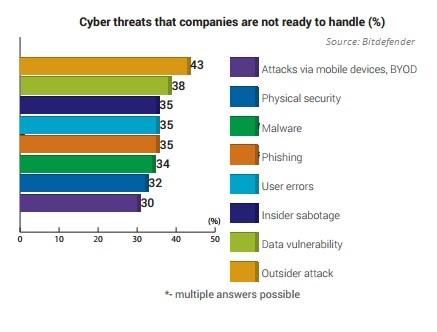
Cyberattacks via mobile devices, physical security and malware top the list of threats that US companies are not ready to handle, according to a recent Bitdefender study.

Outsider attacks give nightmares to US CIOs, according to a Bitdefender survey of 250 IT decision makers at US companies with more than 1,000 PCs. The survey notes that outsider attacks, data vulnerability and insider sabotage are the main threats companies aren’t ready to handle.

CIOs also know that cybercriminals can spend large amounts of time inside organizations without being detected; Advanced Persistent Threats (APTs) are often defined as threats designed to evade detection.

Accessing any type of data, whether stored in the private or public cloud, needs to be done via multiple authentication mechanisms, Bitdefender’s security specialists recommend. This should involve more than just usernames and passwords. For access to critical data, two-factor or biometric data offers additional control and authorization of qualified and accepted personnel. This is especially significant in organizations where access to critical and sensitive data is restricted, and only then under strict security protocols and advanced authentication mechanisms.

Image Source: Bitdefender

Insider sabotage is the third threat IT decision makers can’t yet handle
“To limit the risks of insider sabotage and user errors, companies must establish strong policies and protocols, and restrict the ways employees use equipment and infrastructure or privileges inside the company network,” recommends Bogdan Botezatu, Bitdefender’s senior e-threat specialist. “The IT department must create policies for proper usage of the equipment, and ensure they are implemented.”

In the past two years, companies witnessed a rise in security incidents and breaches, with a significant increase in documented APT type of attacks targeting top corporations or government entities (such as APT-28). This type of attack intends to exfiltrate sensitive data over a long period, or silently cripple industrial processes. In this context, concerns for security are rising to the top, with decisions taken at board level in most companies.

According to the Bitdefender survey of 250 IT decision makers at US companies with more than 1,000 PCs, IT decision makers, CISOs and CEOs are all concerned about security, not only because of the cost of a breach (unavailable resources and/or money lost), but also because their company’s reputation is at risk when customer data is lost or exposed to criminals. The more media coverage a security breach receives, the greater the complexity of the malware causing it. On top of this, migrating corporate information from traditional data centers to a cloud infrastructure has significantly increased companies’ attackable surface, bringing new threats and more worries regarding the safety of the data.

The demand for hybrid cloud, a mix of public cloud services and privately owned data centers, is estimated to be growing at a compound rate of 27% a year, outpacing overall IT market growth, according to researcher Markets and Markets. The company said it expects the hybrid cloud market to reach $85 billion in 2019, up from $25 billion in 2014. (Read the full white paper here.)

This survey was conducted in October 2016 by iSense Solutions for Bitdefender on 250 IT security purchase professionals (CIOs/CEOs/ CISOs – 26 percent, IT managers/directors – 56 percent, IT system administrators – 10 percent, IT support specialists – 5 percent, and others), from enterprises with 1,000+ PCs based in the United States of America.

Razvan, a security specialist at Bitdefender, is passionate about supporting SMEs in building communities and exchanging knowledge on entrepreneurship.

Filed Under: Advanced Persistent Threat, antivirus, Bitdefender, compliance, CyberThreats, endpoint, Malware, Products, Security News

Security Training 101: Stop Blaming The User

2017/01/25 by admin

From Dark Reading - Andrew Howard

To err is human, so it makes sense to quit pointing fingers and start protecting the organization from users — and vice versa.

We’ve all seen them: the “don’t take the bait” anti-phishing posters plastered throughout most enterprises. As companies struggle with the various forms of malicious email, from spearphishing to whaling, I’ve noticed security leaders have begun to emphasize monitoring and deterring human, email-related mistakes. In that vein, companies are inserting language into employee agreements regarding cybersecurity hygiene and creating policies that punish lax security habits.

I believe it’s time that we, as cybersecurity professionals, take a step back and reconsider our approach to user error. After all, to err is human, and our energies would be better served not on assessing blame but on protecting the organization from users — and users from themselves.

A user-education program is of preeminent importance. Every modern control framework, from ISO to the NIST Cybersecurity Framework, requires user education. The problem I see in today’s standard corporate information security program is that user education is the first and only line of defense against many threats. For example, many companies don’t allow personally identifiable information to be transferred unencrypted, but have no data-loss prevention technology to prevent it. Frankly, this is irresponsible. When a Social Security number is accidently put in an email, the user gets blamed — not the information security group. This training-only strategy also creates an environment in which every user has to do the right thing, every time, without failure.

Users Make Mistakes: Be Prepared for It
Several months ago, I witnessed a Fortune 250 CISO dress down his director of governance, risk, and compliance because a recent audit found sensitive information on a shared resource not designed for that purpose. Immediately, the CISO and the director discussed implementing new information-classification training requirements for users and a scanning program to find any mistakes by other users, who would also need more training. This line of thinking appears to be common in less-sophisticated enterprises. No discussion of preventive techniques, only detection and blame.

A common methodology for user interface experience testing is to pretend the user is drunk. The thought is, if a drunk user can navigate your application, a sober one can easily do the same. The same methodology should apply to cybersecurity. In the security professional community, we have failed by counting on users to constantly do the right thing. Our focus must not be on eliminating human errors but on preventing them in the first place.

As a consultant, I have reviewed hundreds of presentations for boards of directors throughout my career. Many CISOs struggle with establishing board-appropriate metrics: they wonder about the right level of reporting detail to include and how much board members will understand. But I can always count on the phishing test PowerPoint slide to appear during a presentation. “How many clicks this quarter versus last quarter? How many repeat offenders, even after training? After we introduced training, the click rate dropped from 44% to 32%.” It’s amazing how similar these slides are across different companies, regardless of the industry.

Typically, I see companies with pre-training click rates in the 20% to 30% range improve significantly after several quarters of effort. The absolute best training programs I’ve seen, at security-conscious companies, produce results in the 2% to 3% range. Although remarkable, even this level is too high when it takes just one administrator to fall for a scam. After all, 2% of 50,000 users is still 1,000 users.

In my opinion, the phishing test click-rate is a terrible metric for reporting. It assumes the user is responsible for phishing-related issues and takes the focus off of developing reliable, technical controls.

I would much rather see companies move the focus to detection, and instead track their phishing reportrate or how many users reported a test phishing email to the security group. Improving the number of users who report phishing emails creates a large “human sensor” network to support the information security operations center. Recently, I worked with a company that has seen great results, with fewer incidents, using this model. The approach also has the added benefit of enabling the information security market to work with carrots — rewarding users who report — versus “using a stick” to punish those who click through.

Ultimately, user errors should be classified into two categories: (1) mistakes anyone can make, and (2) mistakes no one should make. Training programs and detection techniques should be focused on the second category. As a community, we should focus on preventing the first, and to accomplish that, we must move beyond blaming users and accept accountability as security’s gatekeepers.

Filed Under: compliance, CyberThreats, Security News

4 Reasons Why You Should Take Ransomware Seriously

2017/01/24 by admin

From Dark Reading - Dan Larson

The threats keep getting more sophisticated and the stakes keep getting higher. Is your organization ready to meet the challenge?

According to a recent ransomware report from the Institute for Critical Infrastructure Technology (ICIT), 2016 saw a wave of ransomware attacks that were increasingly sophisticated and stealthy. The FBI forecast that the haul from ransomware would reach a billion dollars last year, and it seems as if no industry is safe from being targeted. As ICIT reports, even critical infrastructure entities such as healthcare organizations have become prime targets, with hospitals in the US and Germany paying ransoms rather than risk their patients’ lives.

Why is this alarming increase occurring? ICIT argues that it’s due to the highly profitable nature of ransomware attacks coupled with inadequate enterprise defenses. Combined, these two factors are attracting a more advanced breed of cybercriminal who is motivated by the potential of a bigger payout, faster and more anonymous — and thus less risky — than the advanced persistent threat exploits often used to steal credit card numbers and other sensitive data.

Compounding these challenges is the fact that law enforcement agencies have not provided a unified response to the ransomware threat, in some cases advising victim organizations to pay the ransom to retrieve their data. At the same time, criminal hackers have developed ways to circumvent standard security measures such as sandboxing and intrusion prevention systems.

If that’s not enough to convince you, here are four more reasons to take ransomware seriously:

  1. Ransomware continues to evolve. Whether your organization is the victim of a ransomware exploit that encrypts files or a type that encrypts the master boot record and blocks access to an entire system, the standard solutions you have in place may not be enough to protect you. New variants of ransomware are continually being developed. They employ an array of techniques aimed at circumventing your security, including deleting Volume Shadow Copies, making it impossible to restore from backup files or avoiding detection by hiding in Microsoft macros or JavaScript files. The criminals who develop ransomware have become so sophisticated that many are offering ransomware as a service, widening the pool of potential victims.
  2. Standard security solutions may not protect you. Ransomware’s ability to quickly change and mutate utilizing polymorphic or fileless malware has exponentially increased opportunities for ransomware to find its way into your organization. Conventional endpoint protection that relies on signature-based detection isn’t up to the task of finding ransomware before it strikes. Adding solutions such as whitelisting, the ability to detect indicators of compromise, or machine learning can increase your protection, but in some cases will be unable to prevent an attack. And unlike malware infections that slowly exfiltrate your data so that postinfection detection may minimize loss, in the case of ransomware, prevention is often your only recourse. Once ransomware enters undetected, your data is immediately encrypted and inaccessible, or your systems are locked down.
  3. Compliance may be at stake. Most organizations retain sensitive data that is subject to regulatory legislation mandating its protection. When a breach happens and data is exposed, the victim organization must inform its customers and partners, and can incur substantial fines if regulations are affected. Ransomware attacks may not result in protected data being stolen, but organizations are still responsible for alerting all their constituents if an attack occurs. This can cause significant damage to an organization’s brand. As Dark Reading reports, the Federal Trade Commission (FTC) has come down hard on companies that fail to protect their customers’ data. FTC Chairperson Edith Ramirez recently suggested that a company’s failure to take action to prevent a ransomware attack could result in enforcement action — even if the company hasn’t been the victim of an attack.
  4. Data recovery can be complex and costly. The cost and complexity of recovering files after a ransomware attack are why many companies, particularly smaller organizations, choose to pay the ransom. Even with a comprehensive backup system, in today’s widely distributed organizations, files can be located across hundreds of devices. Though the attack may begin on one laptop, the ransomware could have access to other systems connected to the laptop, resulting in a costly drain on IT resources as they struggle to map and contain the damage. Even worse, if you’re the victim of a new ransomware variant that’s able to delete your backup files, recovery won’t be an option.

The Best Defense Against Ransomware
To combat the escalating level of ransomware sophistication, organizations need a multifaceted approach with complementary prevention and detection methods. One important method is to focus on indicators of attack (IoAs), a form of behavior-based detection that looks at the underlying actions taken by the threat rather than trying to pattern-match a new file to a signature. An IoA can prevent multiple variants and versions of ransomware families, including new ones not detectable by known signatures or features. Coupled with endpoint detection and response, machine learning, and proactive threat hunting by security experts, organizations can ensure that they have the prevention capabilities in place to alert teams of ransomware attempts before encryption can be initiated.

Filed Under: antivirus, Bitdefender, compliance, CyberThreats, endpoint, Malware, Network Access Control, Ransomware, Sophos

  • « Previous Page
  • 1
  • 2
  • 3
  • 4
  • …
  • 32
  • Next Page »

Let us help answer any questions you may have

requestmoreinformation.fw

Security News and Updates

  • Was my information part of a breach?
  • Phishing and stolen credentials
  • Ransomware is the Biggest Threat for Small to Medium Businesses

RSS SecurityWeek

  • 'Critical Severity' Warning for Malware Embedded in Popular JavaScript Library
  • REvil Ransomware Gang Hit by Law Enforcement Hack-Back Operation
  • Microsoft Introduces Security Program for Non-Profits

Contact

  • Contact Us

Request More Info

  • Request Quote

Site Map

  • Site Map

© Copyright 2016 Symtrex Inc. ; All Rights Reserved · Privacy Statement