Symtrex Inc.

Cyber Security Specialist

Call - 866-431-8972 | Send an Email | Request a Quote
Visit Us On FacebookVisit Us On TwitterVisit Us On Linkedin
  • Home
  • Profile
    • Contact Us
    • Security News
    • White Papers
  • Services
    • Compliance Regulations
      • PCI DSS Suite of Products
      • HIPAA/Hitech
      • SOX – Sarbanes Oxley
      • DCID 6/3/NISPOM Chapter 8/JAFAN DoD
      • NERC/FERC
    • Industry Consulting and Implementation
      • Banking and Financial
      • Energy/Utilities
      • Healthcare
      • Retail/Hospitality
    • Security Assessment
  • Security Solutions
    • Sophos
    • Endpoint Security Solutions
      • Bitdefender Business Solutions
      • Sophos Endpoint Protection
    • Forensic Solution – Threat Hunter
    • Network Access Control
      • NetShield
        • NetShield
    • NGFW – UTM – Perimeter Security
      • Sophos Network Protection
    • Security Awareness Training
      • KnowBe4 – Security Awareness Training
      • Sophos Phish Threat
  • White Papers
    • Sophos Webinar Series
  • Security News
    • Blog
    • Sophos Webinar Series
  • Free Security Tools

BitDefender Perspectives - Outsider Attacks Give Nightmares To CIOs, CEOs, CISOs

2017/02/01 by admin

Cyberattacks via mobile devices, physical security and malware top the list of threats that US companies are not ready to handle, according to a recent Bitdefender study.

Outsider attacks give nightmares to US CIOs, according to a Bitdefender survey of 250 IT decision makers at US companies with more than 1,000 PCs. The survey notes that outsider attacks, data vulnerability and insider sabotage are the main threats companies aren’t ready to handle.

CIOs also know that cybercriminals can spend large amounts of time inside organizations without being detected; Advanced Persistent Threats (APTs) are often defined as threats designed to evade detection.

Accessing any type of data, whether stored in the private or public cloud, needs to be done via multiple authentication mechanisms, Bitdefender’s security specialists recommend. This should involve more than just usernames and passwords. For access to critical data, two-factor or biometric data offers additional control and authorization of qualified and accepted personnel. This is especially significant in organizations where access to critical and sensitive data is restricted, and only then under strict security protocols and advanced authentication mechanisms.
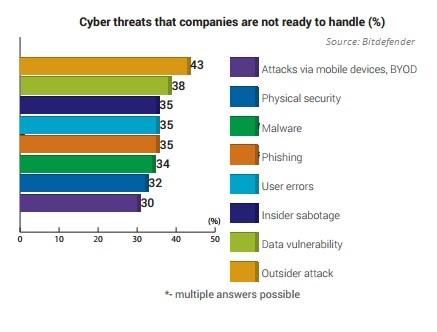
Image Source: Bitdefender

Insider sabotage is the third threat IT decision makers can’t yet handle
“To limit the risks of insider sabotage and user errors, companies must establish strong policies and protocols, and restrict the ways employees use equipment and infrastructure or privileges inside the company network,” recommends Bogdan Botezatu, Bitdefender’s senior e-threat specialist. “The IT department must create policies for proper usage of the equipment, and ensure they are implemented.”

In the past two years, companies witnessed a rise in security incidents and breaches, with a significant increase in documented APT type of attacks targeting top corporations or government entities (such as APT-28). This type of attack intends to exfiltrate sensitive data over a long period, or silently cripple industrial processes. In this context, concerns for security are rising to the top, with decisions taken at board level in most companies.

According to the Bitdefender survey of 250 IT decision makers at US companies with more than 1,000 PCs, IT decision makers, CISOs and CEOs are all concerned about security, not only because of the cost of a breach (unavailable resources and/or money lost), but also because their company’s reputation is at risk when customer data is lost or exposed to criminals. The more media coverage a security breach receives, the greater the complexity of the malware causing it. On top of this, migrating corporate information from traditional data centers to a cloud infrastructure has significantly increased companies’ attackable surface, bringing new threats and more worries regarding the safety of the data.

The demand for hybrid cloud, a mix of public cloud services and privately owned data centers, is estimated to be growing at a compound rate of 27% a year, outpacing overall IT market growth, according to researcher Markets and Markets. The company said it expects the hybrid cloud market to reach $85 billion in 2019, up from $25 billion in 2014. (Read the full white paper here.)

This survey was conducted in October 2016 by iSense Solutions for Bitdefender on 250 IT security purchase professionals (CIOs/CEOs/ CISOs – 26 percent, IT managers/directors – 56 percent, IT system administrators – 10 percent, IT support specialists – 5 percent, and others), from enterprises with 1,000+ PCs based in the United States of America.

Razvan, a security specialist at Bitdefender, is passionate about supporting SMEs in building communities and exchanging knowledge on entrepreneurship.

Filed Under: Advanced Persistent Threat, antivirus, Bitdefender, compliance, CyberThreats, endpoint, Malware, Products, Security News

4 Reasons Why You Should Take Ransomware Seriously

2017/01/24 by admin

From Dark Reading - Dan Larson

The threats keep getting more sophisticated and the stakes keep getting higher. Is your organization ready to meet the challenge?

According to a recent ransomware report from the Institute for Critical Infrastructure Technology (ICIT), 2016 saw a wave of ransomware attacks that were increasingly sophisticated and stealthy. The FBI forecast that the haul from ransomware would reach a billion dollars last year, and it seems as if no industry is safe from being targeted. As ICIT reports, even critical infrastructure entities such as healthcare organizations have become prime targets, with hospitals in the US and Germany paying ransoms rather than risk their patients’ lives.

Why is this alarming increase occurring? ICIT argues that it’s due to the highly profitable nature of ransomware attacks coupled with inadequate enterprise defenses. Combined, these two factors are attracting a more advanced breed of cybercriminal who is motivated by the potential of a bigger payout, faster and more anonymous — and thus less risky — than the advanced persistent threat exploits often used to steal credit card numbers and other sensitive data.

Compounding these challenges is the fact that law enforcement agencies have not provided a unified response to the ransomware threat, in some cases advising victim organizations to pay the ransom to retrieve their data. At the same time, criminal hackers have developed ways to circumvent standard security measures such as sandboxing and intrusion prevention systems.

If that’s not enough to convince you, here are four more reasons to take ransomware seriously:

  1. Ransomware continues to evolve. Whether your organization is the victim of a ransomware exploit that encrypts files or a type that encrypts the master boot record and blocks access to an entire system, the standard solutions you have in place may not be enough to protect you. New variants of ransomware are continually being developed. They employ an array of techniques aimed at circumventing your security, including deleting Volume Shadow Copies, making it impossible to restore from backup files or avoiding detection by hiding in Microsoft macros or JavaScript files. The criminals who develop ransomware have become so sophisticated that many are offering ransomware as a service, widening the pool of potential victims.
  2. Standard security solutions may not protect you. Ransomware’s ability to quickly change and mutate utilizing polymorphic or fileless malware has exponentially increased opportunities for ransomware to find its way into your organization. Conventional endpoint protection that relies on signature-based detection isn’t up to the task of finding ransomware before it strikes. Adding solutions such as whitelisting, the ability to detect indicators of compromise, or machine learning can increase your protection, but in some cases will be unable to prevent an attack. And unlike malware infections that slowly exfiltrate your data so that postinfection detection may minimize loss, in the case of ransomware, prevention is often your only recourse. Once ransomware enters undetected, your data is immediately encrypted and inaccessible, or your systems are locked down.
  3. Compliance may be at stake. Most organizations retain sensitive data that is subject to regulatory legislation mandating its protection. When a breach happens and data is exposed, the victim organization must inform its customers and partners, and can incur substantial fines if regulations are affected. Ransomware attacks may not result in protected data being stolen, but organizations are still responsible for alerting all their constituents if an attack occurs. This can cause significant damage to an organization’s brand. As Dark Reading reports, the Federal Trade Commission (FTC) has come down hard on companies that fail to protect their customers’ data. FTC Chairperson Edith Ramirez recently suggested that a company’s failure to take action to prevent a ransomware attack could result in enforcement action — even if the company hasn’t been the victim of an attack.
  4. Data recovery can be complex and costly. The cost and complexity of recovering files after a ransomware attack are why many companies, particularly smaller organizations, choose to pay the ransom. Even with a comprehensive backup system, in today’s widely distributed organizations, files can be located across hundreds of devices. Though the attack may begin on one laptop, the ransomware could have access to other systems connected to the laptop, resulting in a costly drain on IT resources as they struggle to map and contain the damage. Even worse, if you’re the victim of a new ransomware variant that’s able to delete your backup files, recovery won’t be an option.

The Best Defense Against Ransomware
To combat the escalating level of ransomware sophistication, organizations need a multifaceted approach with complementary prevention and detection methods. One important method is to focus on indicators of attack (IoAs), a form of behavior-based detection that looks at the underlying actions taken by the threat rather than trying to pattern-match a new file to a signature. An IoA can prevent multiple variants and versions of ransomware families, including new ones not detectable by known signatures or features. Coupled with endpoint detection and response, machine learning, and proactive threat hunting by security experts, organizations can ensure that they have the prevention capabilities in place to alert teams of ransomware attempts before encryption can be initiated.

Filed Under: antivirus, Bitdefender, compliance, CyberThreats, endpoint, Malware, Network Access Control, Ransomware, Sophos

Malware Most Common Smart Hospital Data Security Threat

2016/12/06 by admin

By Elizabeth Snell - HealthIT Security

The European Union Agency for Network and Information Security reviewed top smart hospital data security threats, mitigation techniques, and good practices.

Malware is the most common type of potential attack scenario for smart hospitals that poses a data security threat, according to a recent study from the European Union Agency for Network and Information Security (ENISA).

Smart hospitals have become more prevalent as Internet of Things (IoT) components support core functions of a hospital, ENISA stated in its study.

Information security is a key issue for these organizations, and malicious actions, human errors, system and third-party failures, and natural phenomena should all be considered as a potential threat.

“The risks that result from these threats and corresponding vulnerabilities are typically mitigated by a combination of organisational and technical security measures taken by smart hospitals which comprise good practices,” the report’s authors wrote. “With respect to organisational measures, compliance with standards, staff training and awareness raising, a sound security organisation, and the use of guidelines and good practices are particularly relevant.”

ENISA investigated the current status of Smart Hospitals and related information security issues, focusing on deployments in the EU for the study.

Respondents included hospital representatives, industry representatives, and policy makers.

Along with malware, those surveyed said that device tampering, social engineering, denial of service attacks, and theft, were also top attack scenarios for smart hospitals.

Traditional hospitals may also be vulnerable to these types of attacks, researchers noted. However, the consequences can be much more severe in connected organizations.

“Protection becomes difficult because, with the high number of networked devices, many potential points of attack are emerging,” the report states. “The consequences become more severe because information systems and devices are more intensely connected within hospitals and across organisational boundaries.”

Respondents also rated threat categories according to their likelihood of occurrence on a scale from 1 (low likelihood) to 5 (high likelihood). Human errors were the most likely to occur, according to the survey, while a natural phenomena was given the lowest likelihood of taking place.

“With respect to human errors, user errors, non-compliance with policies and procedures and loss of hardware, for instance, were perceived as posing considerable risk to smart hospitals,” the researchers explained.

However, malicious actions, which include threats from malware, social engineering, hacking, denial of service and device tampering, were considered particularly critical for smart hospitals by a larger group of respondents than human errors.

Specifically, 77 percent of respondents said that malicious actions were a critical threat, while 70 percent said human errors were the top threat. Just over half of those surveyed - 53 percent - listed system failures as a critical threat.

ENISA recommended that hospitals establish effective enterprise governance for cybersecurity, and also provide specific IT security requirements for IoT components in the hospital. Conducting a risk assessment and vulnerability assessment were also recommended, which are required for US organizations under HIPAA regulations.

Industry representatives should perform the following measures to enhance smart hospital data security:

  • Incorporate security into existing quality assurance systems
  • Involve third parties (healthcare organisations) in testing activities
  • Consider applying medical device regulation to critical infrastructure components
  • Support the adaptation of information security standards to healthcare

Several of these recommendations are also already being considered for US-based healthcare organizations.

For example, the National Health Information Sharing and Analysis Center (NH-ISAC), the Medical Device Innovation, Safety and Security Consortium (MDISS), and the U.S. Food and Drug Administration (FDA) Center for Devices and Radiological Health (CDRH) recently signed a memorandum of understanding to help organizations identify, mitigate, and prevent medical device cybersecurity threats.

The Information Sharing and Analysis Organization Standards Organization (ISAO SO) also released several documents in October 2016 on cybersecurity information sharing guidance, which focused on cybersecurity risks, incidents, and best practices. In terms of healthcare cybersecurity information sharing, one document discussed privacy and security aspects of cybersecurity risk.

“At a minimum, privacy considerations should include the individual members of an organization, the privacy of any individuals whose data may be included in cyber threat indicators to the extent provided by law, and a full range of other constituencies, customers, and individuals,” the document stated. “To adequately protect privacy while accomplishing the goals of an ISAO, it is important for the ISAO to provide guidance to members, participants, and ISAO staff that will be helpful in striking a balance between allowable sharing of cyber threat information and protecting privacy.”


Filed Under: antivirus, Bitdefender, endpoint, IoT, Kaspersky, Malware, Products, Ransomware, Sophos

Avalanche (crimeware-as-a-service infrastructure)

2016/12/02 by admin

US CERT - National Security Awareness System

TA16-336A: Avalanche (crimeware-as-a-service infrastructure)

12/01/2016 12:00 AM EST

Original release date: December 01, 2016

Systems Affected

Microsoft Windows

Overview

“Avalanche” refers to a large global network hosting infrastructure used by cyber criminals to conduct phishing and malware distribution campaigns and money mule schemes. The United States Department of Homeland Security (DHS), in collaboration with the Federal Bureau of Investigation (FBI), is releasing this Technical Alert to provide further information about Avalanche.

Description

Cyber criminals utilized Avalanche botnet infrastructure to host and distribute a variety of malware variants to victims, including the targeting of over 40 major financial institutions. Victims may have had their sensitive personal information stolen (e.g., user account credentials). Victims’ compromised systems may also have been used to conduct other malicious activity, such as launching denial-of-service (DoS) attacks or distributing malware variants to other victims’ computers.

In addition, Avalanche infrastructure was used to run money mule schemes where criminals recruited people to commit fraud involving transporting and laundering stolen money or merchandise.

Avalanche used fast-flux DNS, a technique to hide the criminal servers, behind a constantly changing network of compromised systems acting as proxies.

The following malware families were hosted on the infrastructure:

  • Windows-encryption Trojan horse (WVT) (aka Matsnu, Injector,Rannoh,Ransomlock.P)
  • URLzone (aka Bebloh)
  • Citadel
  • VM-ZeuS (aka KINS)
  • Bugat (aka Feodo, Geodo, Cridex, Dridex, Emotet)
  • newGOZ (aka GameOverZeuS)
  • Tinba (aka TinyBanker)
  • Nymaim/GozNym
  • Vawtrak (aka Neverquest)
  • Marcher
  • Pandabanker
  • Ranbyus
  • Smart App
  • TeslaCrypt
  • Trusteer App
  • Xswkit

Avalanche was also used as a fast flux botnet which provides communication infrastructure for other botnets, including the following:

  • TeslaCrypt
  • Nymaim
  • Corebot
  • GetTiny
  • Matsnu
  • Rovnix
  • Urlzone
  • QakBot (aka Qbot, PinkSlip Bot)

Impact

A system infected with Avalanche-associated malware may be subject to malicious activity including the theft of user credentials and other sensitive data, such as banking and credit card information. Some of the malware had the capability to encrypt user files and demand a ransom be paid by the victim to regain access to those files. In addition, the malware may have allowed criminals unauthorized remote access to the infected computer. Infected systems could have been used to conduct distributed denial-of-service (DDoS) attacks.

Solution

Users are advised to take the following actions to remediate malware infections associated with Avalanche:

  • Use and maintain anti-virus software – Anti-virus software recognizes and protects your computer against most known viruses. Even though parts of Avalanche are designed to evade detection, security companies are continuously updating their software to counter these advanced threats. Therefore, it is important to keep your anti-virus software up-to-date. If you suspect you may be a victim of an Avalanche malware, update your anti-virus software definitions and run a full-system scan. (See Understanding Anti-Virus Software for more information.)
  • Avoid clicking links in email – Attackers have become very skilled at making phishing emails look legitimate. Users should ensure the link is legitimate by typing the link into a new browser (see Avoiding Social Engineering and Phishing Attacks for more information).
  • Change your passwords – Your original passwords may have been compromised during the infection, so you should change them. (See Choosing and Protecting Passwords for more information.)
  • Keep your operating system and application software up-to-date – Install software patches so that attackers cannot take advantage of known problems or vulnerabilities. You should enable automatic updates of the operating system if this option is available. (See Understanding Patches for more information.)
  • Use anti-malware tools – Using a legitimate program that identifies and removes malware can help eliminate an infection. Users can consider employing a remediation tool. A non-exhaustive list of examples is provided below. The U.S. Government does not endorse or support any particular product or vendor.

Filed Under: Advanced Persistent Threat, antivirus, CyberThreats, Malware, Security News

2017 Security Predictions

2016/12/01 by admin

From CIO - by Sharon Florentine

From W-2 scams to WordPress vulnerabilities, ransomware, business email compromises, DDos attacks and allegations of a hacked presidential election — 2016’s been a hell of a year in cybersecurity, and it’s not over yet.

There’s no reason to believe 2017 will be any better. If anything, it could be even worse as cybercriminals continue to push social engineering, find new ways to deliver malware, crack vulnerable databases and leverage mobile technology to find ways to get inside corporate defenses and target individuals.

We asked two leading cybersecurity experts, Matt Dircks, CEO of secure access software company Bomgar and Scott Millis, CTO at secure device management and mobile security company Cyber adAPT, what to expect in 2017.

1. Passwords ‘grow up’

The recent DDoS attack that wreaked havoc on a huge portion of the internet on Oct. 21was at least partly enabled by unchanged default passwords on IoT devices, says Dircks, which hackers were able to exploit. Don’t think you’re immune; how many of your users have simple, common or outdated passwords? In 2017, Dircks says better password management services will gain traction as businesses understand how vulnerable they are.

“I used to do a party trick where I’d go to someone’s house and hack their router. There are so many purpose-built, ‘dumb’ devices out there like the routers used to facilitate the DDoS attack a few months ago, that it’s making hackers’ jobs easy,” Dircks says.

Cybersecurity professionals will struggle to protect critical infrastructure, connected systems and remotely accessed systems and devices while weak password practices remain the norm, but it’s not just external threats that are a problem.

Mitigating insider threats can also be accomplished through better password management, he says. The best way to do so is to implement a solution that securely store passwords that remain unknown to users, and then regularly validates and rotates those passwords to ensure safety and security, he says.

“What we’re talking about is credential vaults. In an ideal world, a user would never actually know what their password was — it would be automatically populated by the vault, and rotated and changed every week. Look — hackers are intrinsically lazy, and they have time on their side. If you make it harder for them, they’ll go elsewhere rather than invest the energy to chip away,” Dircks says.

2. Privilege gains power

Hackers want high-level access, which they get through targeting the credentials of privileged users like IT professionals, CEOs and vendors, Dircks says. And while organizations have applied security to the systems, applications and data that are most critical to their business, these preventative measures simply aren’t enough anymore. In 2017, he says, savvy organizations will finally get serious about protecting not just systems, but privileged users by identifying them, monitoring their access and closing off access to what they don’t need.

“We’ve had some clients who say, ‘Well, I just stick my users or outside vendors on the VPN and they’re fine,’ but they have no idea what they are actually accessing! With privilege management, think of it like an elevator bank, where depending on your role, you can only get to certain floors. It really limits what you can do, especially if you’re malicious. Even if I do have a valid password, if my privilege lets me access floors one and seven, but I try to go to six, then the system will block me and notify someone,” Dircks says.

Addressing this issue, too, will involve organizations willing to provide extensive education and training on the potential dangers involved, especially in an increasingly mobile workforce where many individuals would rather sacrifice privacy and personal data for access and believe their security will be taken care off by the third-party services providers and application creators, he says.

“Especially in the last few generations of digital natives, people are more than willing to give up their personal information and data for access to apps, connectivity, information — this can easily be exploited. And they are willing to trust that these app developers, these providers, will make sure they’re safe and secure. That’s dangerous. Combine the cybersecurity skills gap, talent shortage, mobile workforce, app-centric environment, more sophisticated hacking and it’s a perfect storm. We think it’s just going to get worse before it gets better,” Dircks says.

3. The security blame game will heat up

“When we talk to our clients, one trend we’re seeing that is really horrifying is that they don’t even say ‘if’ an attack occurs anymore, they say ‘when.’ It’s like, at this point they are just throwing up their hands and saying, ‘Well, I’m gonna get hit, how bad is it going to be?’ and that, to me, is just terrifying,” Dircks says.

The IoT and increasing reliance on security solution providers means companies may not be able to easily account for ownership or origin once a breach happens, he says. Who is responsible for securing, maintaining and patching the various technologies? Worse yet, has a product been connected to internal systems that can’t yet be patched? A number of IoT devices are often overlooked because they fall outside of IT’s traditional purview, but that means exposure to threats.

“With the integration of IoT, automation and the cloud, no one seems entirely sure who’s actually responsible for maintaining security of all these various pieces: the IoT device manufacturer? The security services provider? The internal IT department? Individual users? You’re only as secure as the least-secure device or relationship,” Dircks says.

When a breach occurs, even with layers of security, the question of who “owns” it and who had or has power to do something about it will create intense reactions and finger-pointing, he says.

Companies can head off this blame game by ensuring open communication between IT and business leadership to understand the potential threats, options for security and safety and the challenges and constraints that exist within the organization, Dircks says.

“Part of the problem is that, as a CSO, a CISO or even a CIO — anyone with security responsibility — you’re either invisible, if you’re doing your job right, or you’re on the hot seat. If you come up with great policies, procedures and security measures, then you often leave those to IT to operationalize. But if those fail because you didn’t understand the business needs, the budgets, the requirements, then you’re not really helping,” he says.

4. Ransomware will spin out of control

Since January 1, 2016, Symantec’s Security Response group has seen an average of more than 4,000 ransomware attacks per day: a 300 percent increase over 2015, according to its 2016 Internet Security Threat Report.

Most organizations rely on low-overhead prevention techniques, such as firewall and antivirus solutions or intrusion prevention to mitigate threats like these, says Cyber adAPT’s Scott Millis. However, these tools are insufficient, and breach data shows that detection and incident response must be improved.

And as attackers continue to use social engineering and social networks to target sensitive roles or individuals within an organization to get to data, the need for comprehensive security education becomes even more critical, he says.

“If security policies and technologies don’t take these vectors into account, ransomware will continue to seep in. There’s also the issue of detection. Some attackers can reside within a company’s environments for months, often moving laterally within environments, and silos between network, edge, endpoint and data security systems and processes can restrict an organization’s ability to prevent, detect and respond to advanced attacks,” Millis says.

Finally, new attack surfaces — for example, IaaS, SaaS and IoT — are still so new that organizations haven’t yet figure out the best way to secure them, he says.

5. Dwell times will see no significant improvement

Dwell time, or the interval between a successful attack and its discovery by the victim, will see zero significant improvement in 2017, Millis says. In some extreme cases, dwell times can reach as high as two years and can cost a company millions per breach.

“Why so long? In my view, this is annoyingly simple — there’s little or no focus on true attack activity detection. At the advent of the ‘malware era’, companies, vendors and individuals were rightly concerned about ‘keeping out the bad guys’, and a whole industry grew quickly to focus on two basic themes: ‘Defense-in-depth’, which I view as layering prevention tactics in-line to make penetration from the outside more difficult; and ‘Malware identification’, which manifested itself as an arms race towards 100-percent-reliable identification of malware,” Millis says.

While response technologies and remediation capabilities, improved, victims were able to isolate and repair damage very quickly. The problem is these technologies didn’t help reduce dwell time; unless response teams stumbled upon something malicious or randomly discovered an anomaly, Millis says.

Nowadays, security pros are using network device log files to search for clues as to whether an attack has been attempted or has succeeded, but storing and sorting through the massive amounts of data needed for this approach is costly and inefficient, Millis says.

“The need for huge data stores and massive analytics engines drove the new security information and event management (SIEM) industry. While SIEM is a great after-the-fact forensics tool for investigators, it still isn’t effective in identifying attacks in progress. What we — and some other companies — are doing now is developing products that focus on analyzing raw network traffic to identify attack indicators. Finding attackers as soon as possible after they have beaten the edge or device prevention gauntlet, or circumvented it entirely as an innocent or malicious insider, will dramatically shorten dwell time,” he says.

6. Mobile will continue to rise as a point of entry

At least one, if not more, major enterprise breaches will be attributed to mobile devices in 2017, Millis predicts. A Ponemon Institute report found that for an enterprise, the economic risk of mobile data breaches can be as high as $26.4 million and 67 percent of organizations surveyed reported having had a data breach as a result of employees using their mobile devices to access the company’s sensitive and confidential information.

People and their mobile devices are now moving around way too much, and much too fast, for old-fashioned cybersecurity strategies to be effective, Millis says. Add to that an increasing sense of entitlement by users with regards to the devices they choose to use, and you have a situation ripe for exploitation.

“Many users feel they can protect their privacy while having secure, uninterrupted access to business and personal services. And still many people subscribe to the view it is not they who are accountable for security breaches; if they can work around ‘security’ to improve their user experiences, they will. CISOs, CIOs and CEOs view this as a complex challenge to the implementation of their enterprise security strategies, and one that won’t be solved by having email and calendar data delivered over SSL to a single, approved OS,” Millis says.

Mobile payments, too, will become a liability. MasterCard’s ‘selfie pay’ and Intel’s True Key are just the tip of the iceberg, he says. Individuals should understand that they need to treat their biometric data just as carefully as they do other financial and personal data; again, that comes down to education and training, he says.

“Wouldn’t it be nice if public Wi-Fi access providers were required to put up the internet allegory to the warnings on cigarette packs? Something like, ‘Warning: This public access connection is not secure and information you send and receive while connected may possibly be viewed, collected and subsequently used by criminals to steal your assets, identity or private information,'” Millis says.

7. Internet of threats?

IoT vulnerabilities and attacks will rise and will increase the need for standardization for various security measures — hackers at this year’s Def Con found 47 new vulnerabilities affecting 23 devices from 21 manufacturers.

And, of course, in October 2016 the massive DDoS attack on major global websites including Twitter, Netflix, Reddit and the UK government’s sites — was reportedly powered by the Mirai botnet made up of insecure IoT devices.

“A lot of attention is focused on ‘smart devices’ as proof of IoT’s growing influence. The reality is a connected device doesn’t make it a smart device. The ‘things’ that are being connected often ‘fire-and-forget’ in their simplicity, or are built-in features and tools we may not even know are there — like the routers used in the Mirai botnet. This leads to a mindset of ignoring these ‘dumb’ devices without paying attention to the fact that these devices, while inherently ‘dumb’, are connected to the biggest party-line ever made: the internet,” says Bomgar’s Matt Dircks.

This isn’t just a problem for smaller consumer devices, or even for connected homes and cars. Dircks isn’t even particularly focused on the possibility of another DDoS attack. What’s more troubling is the potential for an attack on large, widespread infrastructure systems like the power grid, or even avionics or railway systems, he says.

“I’m not worried about things like, if my connected showerhead turns on hot or cold. I think there’s a fairly significant chance we’ll see a major hack on power grids or on transportation systems like rail in 2017. This is the ‘dumb’ IoT that’s still out there — the technology from the 1950s and 1960s that’s powering these critical infrastructure systems that is almost totally unsecured,” he says.

This is a perception problem; the general public doesn’t tend to see these systems as being similar to the IoT devices they use with increasing frequency — even mobile phones can fall into that category, says Millis.

“Like smart-phones before them, IoT devices are assumed to be new, separate, and not subject to the same limits, as older technology, but think about it. It’s nonsense: Smartphones are the most plentiful internet device around. IoT is the next hyper-jump in scale. Some organizations are wisely ahead of the curve a little bit this time, trying to head off the same security issues that mobile devices are facing now. So far, activity here has all come down to prevention yet again, but we believe every device and/or connection can be compromised. Shortening dwell time and securing IoT depends on being able to tell when that inevitably happens, as quickly as possible and with the highest level of confidence,” Millis says.


Filed Under: Advanced Persistent Threat, antivirus, CyberThreats, IoT, Malware, Products, Ransomware, Security News

  • « Previous Page
  • 1
  • 2
  • 3
  • 4
  • 5
  • …
  • 24
  • Next Page »

Let us help answer any questions you may have

requestmoreinformation.fw

Security News and Updates

  • Was my information part of a breach?
  • Phishing and stolen credentials
  • Ransomware is the Biggest Threat for Small to Medium Businesses

RSS SecurityWeek

  • 'Critical Severity' Warning for Malware Embedded in Popular JavaScript Library
  • REvil Ransomware Gang Hit by Law Enforcement Hack-Back Operation
  • Microsoft Introduces Security Program for Non-Profits

Contact

  • Contact Us

Request More Info

  • Request Quote

Site Map

  • Site Map

© Copyright 2016 Symtrex Inc. ; All Rights Reserved · Privacy Statement